Chapters and reference
Module II · Single-sequence circular maps · Section 11 of 12
2.10 pETDuet-1: dense annotations
On this page
See Flagship data sources and construction for provenance, display selections and rebuilding. This page loads bundled inputs directly and focuses on plotting settings.
1 Dense, complete annotation inputs
This independent pETDuet-1 example demonstrates the interaction of complete annotations, primers and enzyme labels at a normal output size. It does not depend on objects from the pUC19 page.
R · Example code
make_reference_map <- function(record, paper = "white") {
  sequence <- record$seq_data
  features <- record$features
  sites <- record$sites
  primers <- record$primers
  all_site_count <- record$all_site_count
  policy <- record$policy
  position <- position_feature_stack(spacing = 0.085, base_position = position_plasmid())
  plot <- ggchord(sequence[c("accver", "length")], feature_data = features) +
    geom_seq(seq_style = "double") +
    geom_feature_plasmid(position = position) +
    geom_feature_label_repel(position = position, label_fit = "shrink", label_min_size = 2.5) +
    geom_seq_center_label() + coord_circular() + theme_ggchord_plasmid()
  if (nrow(sites)) plot <- plot + geom_restriction_site(data = sites, label_size = 2.5)
  if (nrow(primers)) plot <- plot + geom_primer(data = primers) +
    geom_primer_label_repel(data = primers, size = 2.5)
  if (paper != "white") plot <- plot + theme(
    plot.background = element_rect(fill = paper, colour = NA),
    panel.background = element_rect(fill = paper, colour = NA))
  list(plot = plot, features = features, primers = primers, sites = sites,
    all_site_count = all_site_count, policy = policy)
}
R · Example code
reference <- make_reference_map(flagship_circular_example$references[["pETDuet-1"]])
p <- reference$plot
view_ggchord(p, width = 10, height = 8, units = "in")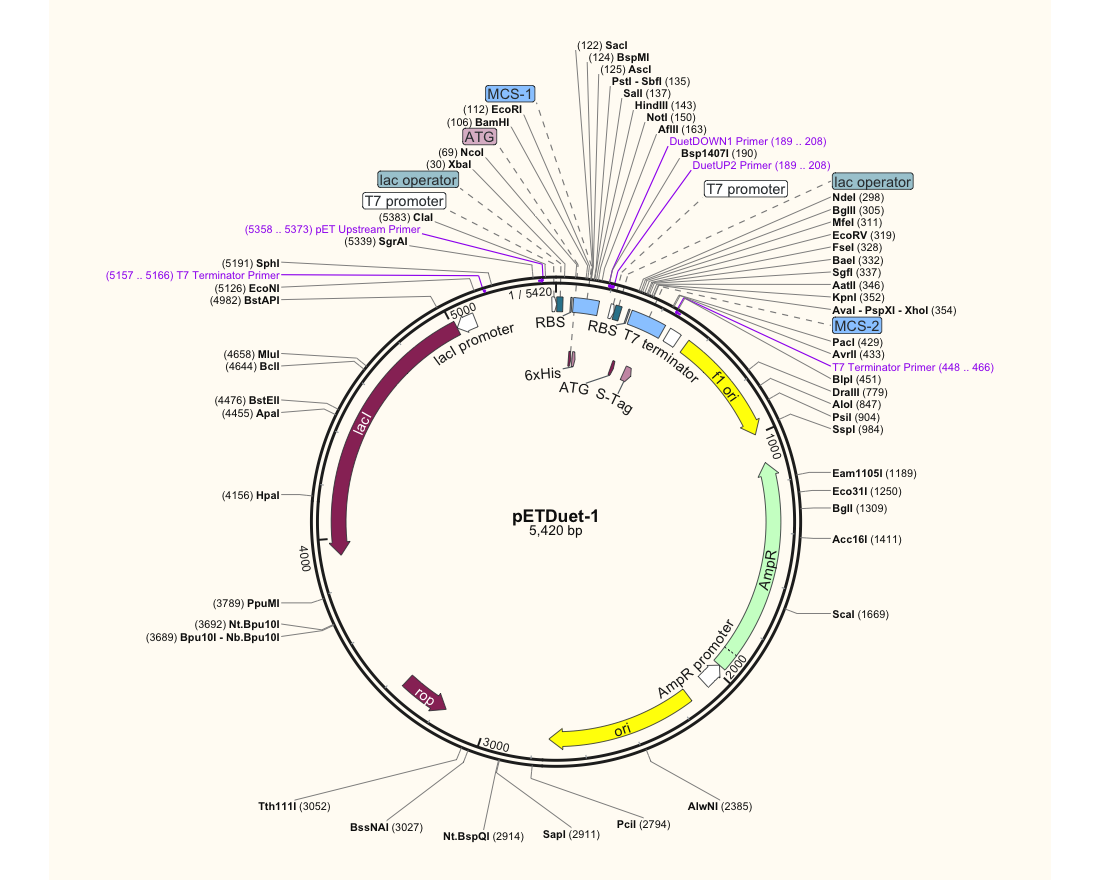
2 What complete means here
All 20 features, 5 independent reference primers and 58 site rows in the selected profile are supplied. These sites occupy 54 distinct positions. The source saves an empty enzyme profile, so the explicit policy is unique six-or-more-base commercial nonredundant cutters. Enzyme-profile selection and arbitrary display sampling are different operations.
3 Label and geometry responsibilities
Stacking determines feature bands. The label layer first uses available internal space and can move text outside; shared source positions remain fixed. A shared enzyme label can describe several rows at one position. Do not infer source counts from the number of text strings.
4 More room without deleting data
The same plot can be exported on a wider canvas. This changes physical space; it does not alter features, selected sites, strands or complete length. Check label diagnostics when selecting an output size.
R · Example code
ggsave("pETDuet-complete.png", p, width = 16.5, height = 8, units = "in", dpi = 144)