Chapters and reference
Complete canonical API text; task articles explain the workflows. Usage guide

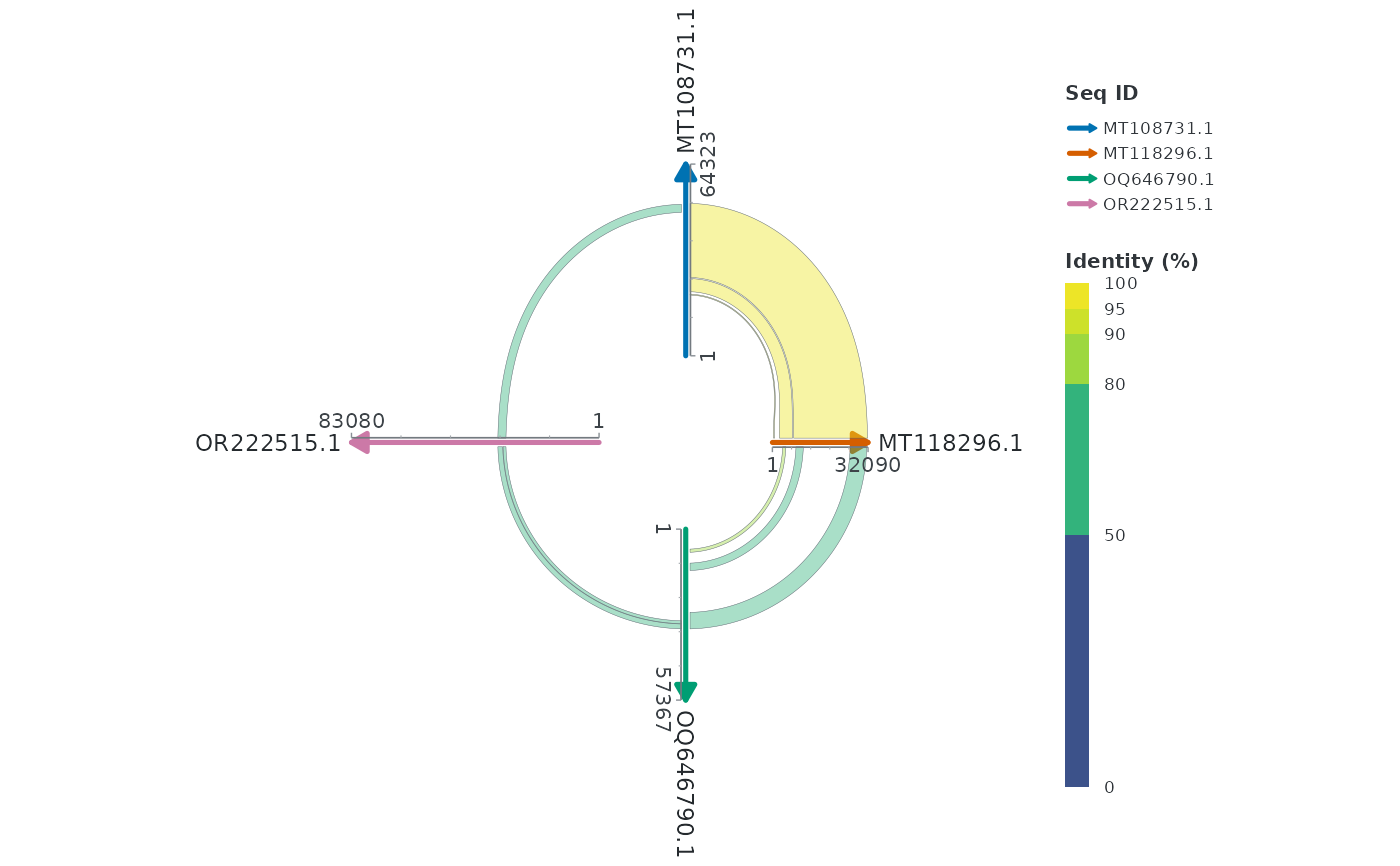
Displays linear sequences as equally spaced outward spokes. Adjacent spokes, including the last and first, may be joined by existing interval alignments. No missing relationship is created. Two spokes display each input HSP once; one spoke is not a multi-sequence synteny view.
Usage
R · Example code
coord_radial_synteny(
  start_angle = 90,
  clockwise = TRUE,
  inner_radius = 0.6,
  ratio = 1,
  xlim = NULL,
  ylim = NULL,
  expand = FALSE,
  clip = "off",
  fit = c("labels", "geometry", "manual"),
  nonadjacent_bulge = 0
)
Arguments
- start_angle
Direction of the first outward spoke in degrees, counterclockwise from the positive x axis. Default 90 starts at noon.
- clockwise
Logical, order subsequent spokes clockwise, default TRUE.
- inner_radius
Positive inner radius in layout units, default 0.6. The longest proportional spoke has length 2. The central hole is display spacing and does not remove any source positions.
- ratio
Fixed y/x aspect ratio, default 1.
- xlim, ylim
Optional user limits. Explicit limits take priority over automatically fitted limits.
- expand
Logical. Expand coordinate limits, default FALSE. Automatic fitting already includes a small safety margin; set TRUE to request the additional ggplot2 coordinate expansion.
- clip
Whether drawing is clipped to the panel, default
"off".- fit
Fitting strategy:
"labels"includes measured label boxes,"geometry"fits geometric elements only, and"manual"requires explicitxlimandylim.- nonadjacent_bulge
Non-negative outward lift at the midpoint of nonadjacent annular ribbons, in layout units (the longest proportional spoke has length 2). Default 0 retains the original path. The lift and its slope vanish at both endpoints. Adjacent ribbons and point links are unchanged. A positive lift also separates overlapping nonadjacent ribbon midpoints in the same channel, retaining their individual interval widths; this does not eliminate crossings forced by source endpoint order. Explicit
geom_link_ribbon(link_ctrl_point = ...)takes priority.
Details
Uses the same sequence, feature, track, label and link layers as
coord_collinear(). geom_seq(seq_order = ...) orders spokes and declares
named repeated display instances; ambiguous relationships require between.
Lengths are proportional by default; geom_seq(length_mode = "equal")
explicitly normalizes display lengths while retaining native positions.
Positive feature/track offsets point counterclockwise from each outward
spoke, independently of biological direction and display order. Sequence
names are placed just beyond the outer ends to keep the central hole clear.
Ribbons default to cyclic neighbors. Use explicit pairs or
adjacent_only = FALSE for nonadjacent ribbons; point links to nonneighbors
require explicit between. Adjacent ribbon outlines are solid; nonadjacent
outlines are dashed, following the final cyclic spoke order. Explicit fixed
or mapped line types take priority. Default curved connections stay in an annular
channel, retaining the complete interval fronts and inversion twists.
Explicit control points use final layout x/y units. Shared link branches,
circular-only annotations, shared straight scale bars and joined multi-window
rows are unsupported. Use the native position axis on each spoke.
Interval fronts use closed one-based interval boundaries
[min(start,end)-1, max(start,end)] in input direction. A one-position
interval retains nonzero width. Axis ticks and position mapping use
one-based positions; this new view does not change existing view conventions.
Examples
R · Example code
data(seq_data_example)
data(ribbon_data_example)
ggchord(seq_data_example, ribbon_data_example) +
  geom_seq() +
  geom_link_ribbon() +
  geom_seq_label() +
  coord_radial_synteny(start_angle = 90, inner_radius = 0.7)